A treatment's price isn't the same as what it earns you. The Practice money card on your Income page shows what each service really makes you per hour, once the time around the session is counted too.
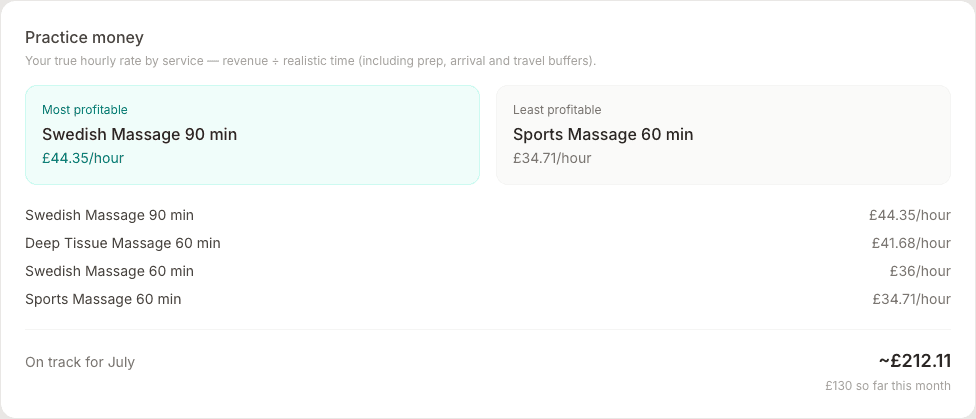
True hourly rate
For each service, MassageHub divides what you've actually taken by the realistic time it takes — not just the treatment length, but your setup time, early-arrival buffer and any travel buffer set on the location. So a quick, well-priced session that turns over fast can quietly out-earn a longer, pricier one that ties up your day once you count the setup and the travel.
The length used is what was actually booked, start to finish, so an add-on that stretches a session is counted too — not the nominal length on your services list.
Those buffers are the figures you've saved in Settings. The card isn't measuring the distance to each client, so a treatment doesn't score worse just because that client happened to live further away.
Where you've seen two or three people at one address back to back, the travel and setup are counted once for the trip rather than once per treatment — you only drove there and unpacked once.
The rates always cover your last 12 months counting back from today. They don't move with the month you've picked further up the page, which keeps them steady enough to price against.
Most and least profitable
The card names your most and least profitable service by that hourly rate, and lists every service in between with the number of sessions behind it. It's a quiet prompt — worth a look before you next set or review your prices.
A treatment needs at least three paid sessions before we'll call it your best or worst earner. One session tells you almost nothing, and it shouldn't be what sets your headline rate. Until then you'll see “not enough sessions yet” — the full list is still there underneath.
What's left out
Sessions where nothing came in — a complimentary treatment, a session you never priced, one you refunded in full — are left out of the rates entirely, so they don't drag a treatment down. The card tells you how many were set aside.
That's also why the session count beside a treatment can be lower than the number of times you know you did it. The count is paid sessions, because those are the ones the rate is built from — so a treatment you gave four times, twice for free, shows two.
That does mean these rates show what your paid work earns. Time spent on free sessions isn't counted against them.
If most of your sessions have no price recorded, we hold off on naming a best and worst at all — a comparison built on a handful of priced sessions would be more misleading than helpful. Add prices as you go and it fills in on its own.
Sessions paid for with a package are also left out of the rates, since that money was taken when the package was bought.
Everything here is worked out from bookings you've already completed, so there's nothing to set up and nothing to keep updated.